



Blog
Kawase Hasui Art: Elevating Modern Japanese Decor
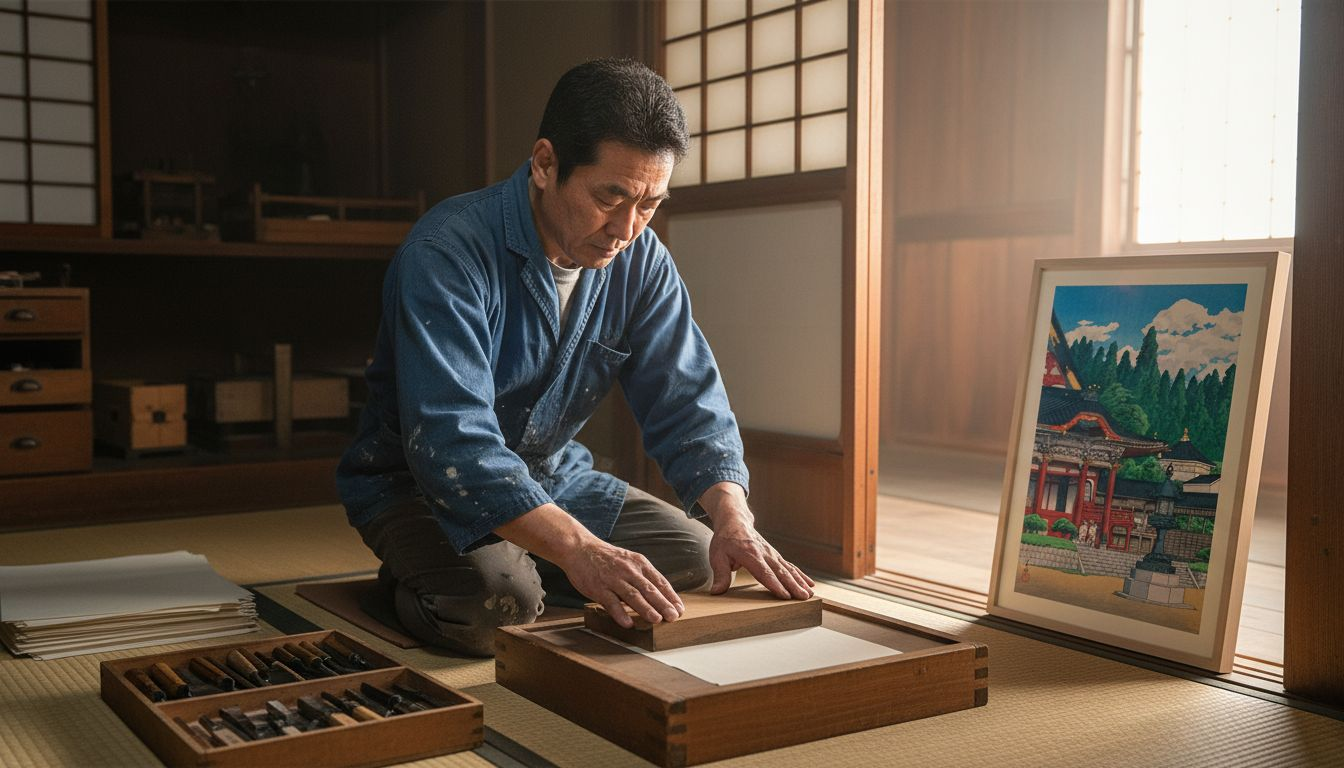
Finding wall art that feels both distinctive and meaningful can be a challenge for many homeowners. For those who admire Japanese ukiyo-e prints and crave sophistication in their interiors, Kawase Hasui’s work stands out as a bridge between tradition and modern design. By introducing serene Japanese landscapes infused with subtle Western realism, Hasui’s prints offer a tranquil spotlight and a rich cultural story that can instantly transform your living space into a haven of calm and artistry.
Table of Contents
- Shin-hanga and Hasui’s Artistic Foundations
- Key Themes and Styles in Hasui’s Prints
- Crafting Woodblock Prints: Process and Collaboration
- Collecting Hasui Art: Value and Authenticity
- Integrating Hasui Art into Home Interiors
Key Takeaways
| Point | Details |
|---|---|
| Shin-hanga Movement | This artistic revolution revitalised the ukiyo-e tradition by integrating Japanese aesthetics with Western techniques, creating prints that capture contemporary Japanese life. |
| Kawase Hasui’s Mastery | His focus on tranquil landscapes and skillful use of light connects viewers with the essence of place, making his works desirable for modern interiors. |
| Collaborative Printmaking Process | The production of Hasui’s prints involved a team of specialists, ensuring quality and craftsmanship that enhances their collectible value. |
| Integration in Modern Décor | Hasui’s serene prints work harmoniously in various settings, especially in spaces prioritising tranquility, such as bedrooms and studies. |
Shin-hanga and Hasui’s Artistic Foundations
Shin-hanga emerged during Japan’s dramatic transformation in the late 19th and early 20th centuries. This movement revitalised the ancient ukiyo-e tradition by blending Japanese aesthetics with Western artistic techniques, creating something entirely new.
Kawase Hasui stood at the centre of this artistic revolution. Born in 1883, Hasui specialised in tranquil landscapes that captured atmospheric effects and natural light, often depicting lesser-known Japanese locales that traditional artists had overlooked.
What made shin-hanga different from its predecessor ukiyo-e?
- Western-influenced realism and perspective techniques
- Greater emphasis on light, shadow, and atmospheric mood
- Depiction of modern Japan alongside traditional scenes
- Higher production quality and vibrant colour palettes
- Focus on contemporary leisure destinations and natural beauty
Hasui’s training combined traditional nihonga painting with Western-style techniques, giving him a unique ability to bridge two artistic worlds. This hybrid approach resonated with audiences searching for a new Japanese identity that honoured tradition whilst embracing modernity.
The shin-hanga movement reflected Japan’s cultural transformation during rapid modernisation. Hasui’s works offered landscapes that felt both deeply Japanese and remarkably fresh, capturing moments of serene beauty rather than dramatic action.
His collaboration with publisher Watanabe Shōzaburō proved transformative. Together they elevated shin-hanga internationally, establishing it as a serious art form worthy of recognition beyond Japan’s borders.
Why does this matter for your décor today? Hasui’s prints represent a precise moment when East met West artistically. Owning one means bringing home a piece of this cultural crossroads, a quiet rebellion against artistic convention that feels as relevant now as it did a century ago.
Pro tip: When selecting a Hasui print for your space, look for compositions featuring water, mist, or twilight scenes—these showcase his masterful use of light and atmosphere, transforming ordinary landscapes into contemplative focal points that elevate any room’s ambiance.
The following table highlights how Hasui’s shin-hanga prints differ from traditional ukiyo-e and why these distinctions matter for modern collectors and interiors:
| Aspect | Ukiyo-e Tradition | Shin-hanga Innovation | Modern Décor Relevance |
|---|---|---|---|
| Visual Focus | Flat, stylised figures | Depth, nuanced atmosphere | Invites tranquillity in the home |
| Cultural Portrayal | Historic, everyday life | Blend of past and present | Bridges traditional and contemporary rooms |
| Use of Light | Limited shading, bold colour | Dynamic light effects | Enhances room ambiance, softens spaces |
| Artistic Collaboration | Artist-led with skilled artisans | Multi-specialist teamwork | Ensures consistency and craft quality |
Key Themes and Styles in Hasui’s Prints
Hasui’s work stands apart within shin-hanga through his laser focus on landscape and townscape subjects. While other artists explored varied themes, Hasui devoted himself almost exclusively to capturing the essence of place, light, and atmosphere.
His artistic approach blended Western perspective and three-dimensionality with Japanese sensibility. This fusion created prints that feel both contemporary and deeply rooted in tradition, bridging two artistic worlds seamlessly.
What defines Hasui’s visual style?
- Emphasis on subtle atmospheric effects rather than dramatic action
- Realistic, objective depiction of scenes with careful attention to light and shadow
- Selection of lesser-known locales overlooked by traditional artists
- Integration of modern elements like electric poles and ferries within traditional Japanese landscapes
- Tranquil mood that celebrates Japanese beauty and cultural continuity
Hasui had an eye for finding poetry in ordinary moments. A quiet street after rainfall, mist hovering over a temple, the soft glow of evening lanterns—these became his subjects. This approach transformed mundane scenes into meditative experiences.
His prints often depict contemporary Japan without glorifying it. Modern infrastructure appears naturally within compositions, showing how tradition and progress coexist. This realism resonates with North American homeowners seeking decor that feels both cultured and grounded.
Hasui’s genius lay in capturing tranquility through objective realism, proving that beauty exists in simplicity and light rather than drama or action.
The muted colour palettes and soft gradations in his work create calming effects perfect for living spaces. Each print invites contemplation rather than demanding attention, making them ideal focal points for bedrooms, studies, or meditation areas.
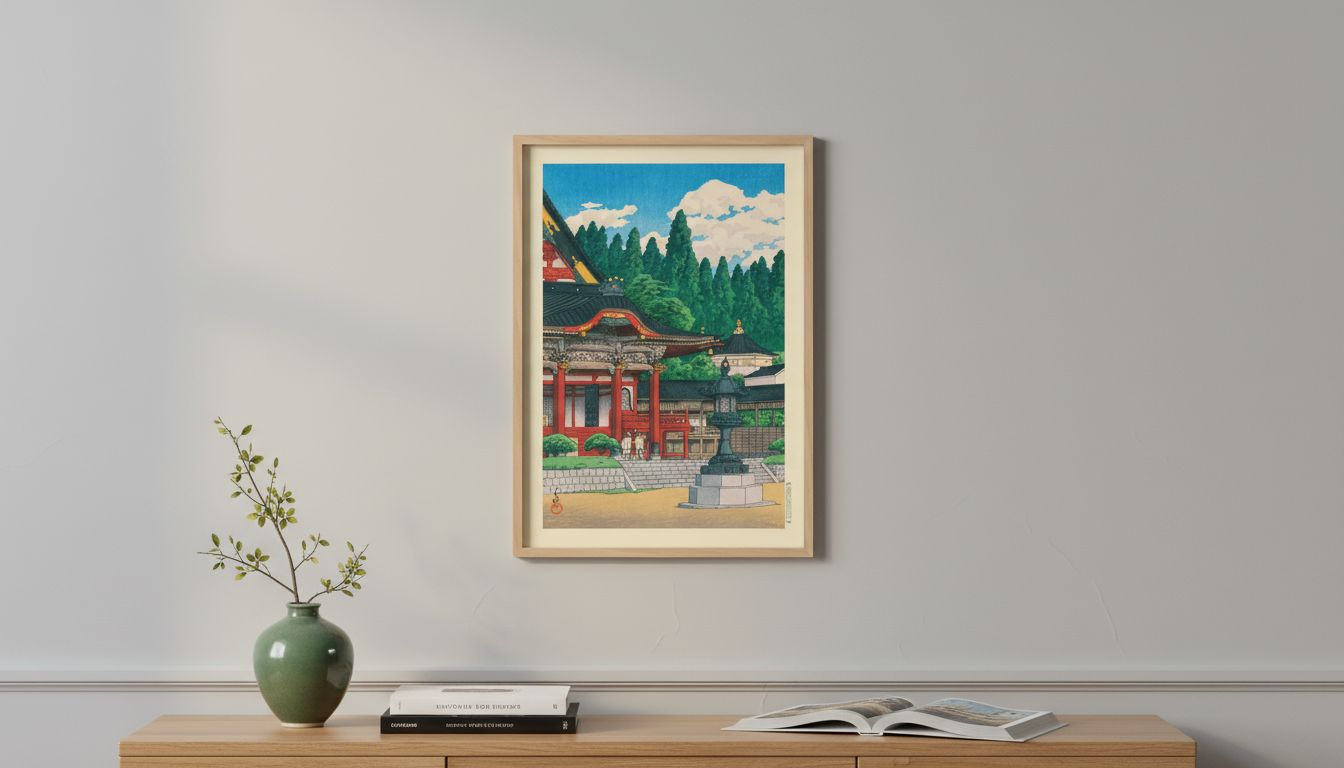
Pro tip: Look for Hasui prints featuring water—rivers, lakes, or rain-soaked streets—as these showcase his masterful manipulation of light and reflection, adding depth and serenity to any room whilst serving as natural conversation starters about Japanese artistic tradition.
Crafting Woodblock Prints: Process and Collaboration
Creating a Hasui woodblock print required far more than one artist’s vision. The process involved a carefully orchestrated team of specialists, each bringing expertise to transform design into finished artwork.
The journey began with Hasui’s detailed sketches and designs. These weren’t quick concepts—they represented careful composition, light studies, and atmospheric planning that would guide the entire production.
How did the collaborative process work?
- The artist created the original design with precise details
- Skilled carvers translated the design into wooden blocks
- Printers applied colours in careful layers using separate blocks
- The publisher supervised quality and managed production
Traditional woodblock printmaking techniques were adapted with modern sensibilities during the shin-hanga period. Rather than abandoning old methods, artisans refined them, blending time-honoured craftsmanship with contemporary artistic goals.
Multiple wooden blocks represented different colours. The printer would apply one colour, carefully align the next block, and repeat this process dozens of times. Perfect registration—matching each block precisely—separated masterpieces from failures.
The collaborative shin-hanga system balanced artistic vision with exceptional craftsmanship, ensuring each print met rigorous standards.
The shin-hanga printmaking movement mirrored traditional ukiyo-e methods whilst incorporating Western-influenced perspectives and light effects. Publisher Watanabe Shōzaburō worked alongside Hasui, carefully selecting carvers and printers who understood his artistic intentions.
This collaboration produced remarkable consistency. Every Hasui print you see today represents countless hours of skilled labour, not just artistic genius. The carver’s chisel work, the printer’s colour layering, and the publisher’s oversight all contributed equally.
When you own a Hasui print, you’re holding evidence of this entire team’s dedication. The subtle gradations, perfect registration, and vibrant colours result from their combined expertise and commitment to excellence.
Pro tip: Examine the reverse side of your Hasui print under good light to spot registration marks and colour layer overlaps—these reveal the remarkable skill involved in creating these woodblock masterpieces and deepen your appreciation for traditional craftsmanship.
Collecting Hasui Art: Value and Authenticity
Hasui’s prints command attention from collectors worldwide. His status as a Living National Treasure and one of shin-hanga’s greatest landscape artists ensures continued demand for his works across global art markets.
What drives the value of Hasui prints? Rarity matters most. Original woodblock prints from his era are genuinely scarce, especially high-quality impressions that survived natural disasters and wars intact. The fewer prints in existence, the higher their value becomes.
Authenticating a genuine Hasui print requires careful examination across multiple dimensions:
- Verify the artist’s signature and seal match documented examples
- Check edition numbers and publisher marks from Watanabe Shōzaburō
- Examine paper quality and type used during the shin-hanga period
- Assess colour vibrancy and ink application techniques
- Investigate the print’s provenance and ownership history
Hasui’s woodblock prints hold significant cultural importance within the shin-hanga movement, driving consistent collector interest. Demand remains strong because his works represent peak artistic achievement in Japanese landscape printmaking.
Condition dramatically affects price. A pristine print with vibrant colours commands substantially more than one with fading, foxing, or staining. Even minor damage reduces value considerably, so preservation matters immensely.
The value of Hasui’s prints depends on rarity, condition, edition quality, and documented provenance—each factor contributes to market worth.
Authenticity verification requires expert knowledge. Professional evaluation examines paper, colour, signatures and publisher seals to confirm genuineness. Counterfeit Hasui prints exist, making expert authentication crucial before significant investment.
Collectors should understand that owning a Hasui print represents both aesthetic appreciation and tangible investment. These works appreciate over time due to scarcity and enduring artistic significance.
ArtMandre offers carefully curated Hasui prints with documented authenticity, allowing North American homeowners to acquire genuine works confidently whilst supporting quality craftsmanship.
Pro tip: Request detailed provenance documentation and authenticity certificates when purchasing Hasui prints; cross-reference signatures and seals against reference collections to verify genuineness before committing to significant expenditure.
Here’s a concise guide to identifying an authentic Hasui print versus a reproduction:
| Attribute | Genuine Hasui Print | Modern Reproduction |
|---|---|---|
| Paper Quality | Vintage washi, aged feel | Bright, uniform paper |
| Signature & Seal | Hand-printed, matched to period | Often machine-printed or missing |
| Colour Saturation | Rich, subtle gradations | Sometimes overly vivid or flat |
| Provenance | Traceable history | Lacks verifiable background |
Integrating Hasui Art into Home Interiors
Hashui’s prints transform living spaces through their serene landscapes and contemplative mood. Their muted colour palettes and subtle atmospheric effects create a calming environment that complements both minimalist and traditional décor approaches.
Where should you display Hasui prints in your home? Think about rooms where tranquility matters most. Bedrooms, studies, meditation spaces, and quiet reading nooks benefit tremendously from his peaceful imagery.
How do you integrate these prints effectively?
- Place prints at eye level on accent walls for maximum visual impact
- Use simple, understated frames that don’t compete with the artwork
- Pair multiple Hasui prints together for a cohesive gallery wall
- Position prints near natural light sources to enhance atmospheric effects
- Leave adequate white space around prints for breathing room
Hasui’s calm, nostalgic scenes provide harmonious aesthetics suited to modern home décor. His use of natural light and muted tones blend seamlessly with contemporary interior styles that value subtlety and cultural richness.
Consider your room’s existing colour scheme carefully. Hasui’s prints work beautifully in spaces with neutral palettes—greys, whites, soft blues, and warm neutrals. The prints complement rather than dominate these backgrounds.
Serene landscapes and subtle colour palettes make Hasui’s works ideal additions to modern Japanese-inspired décor, adding cultural depth and tranquility.
Size matters significantly. A large Hasui print commands attention as a focal point, whilst smaller prints work beautifully in arrangements or symmetrical displays. Measure your wall space before selecting prints to ensure proper proportions.
Authentic woodblock prints or high-quality reproductions both enhance home ambiance effectively. ArtMandre offers carefully selected Hasui prints that maintain artistic integrity whilst providing affordable access to these masterpieces.
Lighting affects how your print appears throughout the day. Avoid direct sunlight exposure, which fades colours over time. Instead, position prints where natural light illuminates them without harsh glare.
Pro tip: Hang Hasui prints at a slight angle or group them with Japanese ceramics, textiles, or minimal furniture to create a cohesive Japanese-inspired vignette that transforms an entire room’s atmosphere.
Elevate Your Living Space with Kawase Hasui’s Timeless Shin-hanga Prints
Embrace the serene beauty and cultural richness of Kawase Hasui’s shin-hanga art to transform your home into a tranquil sanctuary. If you seek wall décor that bridges traditional Japanese aesthetics with modern design, Hasui’s masterful landscapes offer subtle atmospheric effects, balanced light, and muted colour palettes that invite calm and reflection. These are perfect for living rooms, studies or meditation spaces where peace and elegance are paramount.

Discover an exclusive selection of authentic and inspired prints at ArtMandre where quality craftsmanship meets accessible style. Our collection supports your goal of creating a harmonious environment with art that honours legacy and complements contemporary interiors. Act now to take advantage of our promotional offers and bring home a piece of Japan’s artistic crossroads today. Explore our handpicked pieces and start your journey in elevating your décor at https://artmandre.com.
Frequently Asked Questions
What is shin-hanga and how does it differ from ukiyo-e?
Shin-hanga is a modern Japanese printmaking movement that blends traditional ukiyo-e techniques with Western artistic methods. Unlike ukiyo-e, shin-hanga emphasises realism, light, and atmosphere, showcasing contemporary Japan alongside traditional scenes.
How can I integrate Kawase Hasui’s prints into my home decor?
To effectively integrate Hasui’s prints, display them at eye level on accent walls, pair them together for a cohesive gallery, and ensure they are near natural light sources to enhance their atmospheric effects. Use simple frames to complement the artwork without competing for attention.
What defines the artistic style of Kawase Hasui?
Kawase Hasui’s artistic style is characterised by subtle atmospheric effects, realistic depictions of landscapes, and a focus on lesser-known locales. He masterfully integrates modern elements into traditional Japanese scenes, creating tranquil imagery that resonates with viewers.
How do I determine the authenticity of a Hasui print?
To verify a Hasui print’s authenticity, check for the artist’s signature and seal, edition numbers, paper quality, and assess colour vibrancy. Provenance and ownership history also play crucial roles in confirming genuineness.